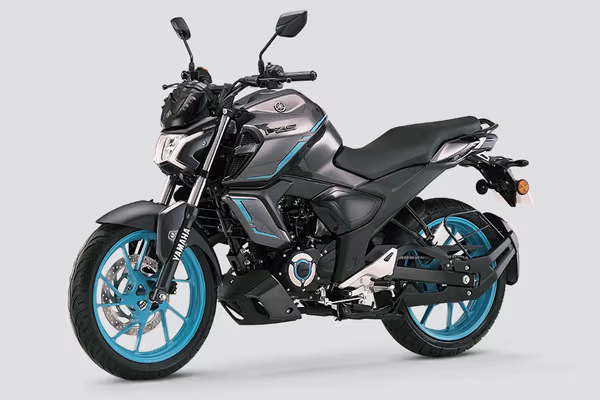
Yamaha FZ-S Fi
₹1.31 Lakh
ex-showroom
On-road ₹1.39 Lakh
Wins 2 of 8

Yamaha FZ-S Fi (₹1.31 Lakh - ₹1.41 Lakh) vs Bajaj Pulsar NS160 (₹1.26 Lakh - ₹1.35 Lakh): compare price, on-road cost, mileage, safety, specifications and features side by side, and see which one suits you.
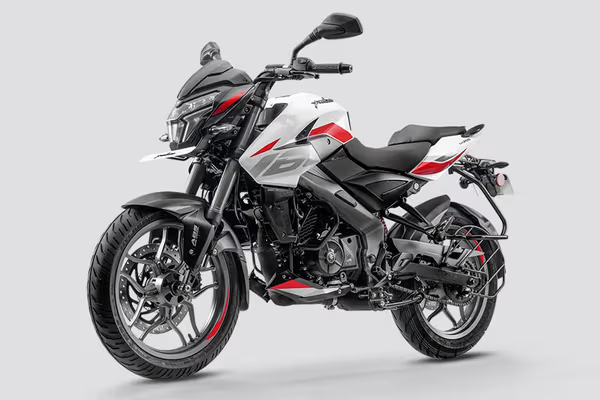 Wins most
Head-to-head figures compare the FZ-S Fi FZ-S Fi STD and Pulsar NS160 Pulsar NS160 Single Channel (the cheapest variants); the at-a-glance table covers every variant on sale.
Pick the Yamaha FZ-S Fi if you want better mileage and less weight.
Pick the Bajaj Pulsar NS160 if you want a lower price, more power, more torque, more ground clearance, a higher top speed and more features.
| At a glance | Yamaha FZ-S Fi | Bajaj Pulsar NS160 |
|---|---|---|
| Price range (ex-showroom) | ₹1.31 Lakh - ₹1.41 Lakh | ₹1.26 Lakh - ₹1.35 Lakh |
| Variants on sale | 2 | 2 |
| Body type | Sports | Sports |
| Fuel options | Petrol | Petrol |
| Transmission | Manual | Manual |
| Best claimed mileage | 60 kmpl | 40.36 kmpl |
Longer bar = bigger number. The winner of each row is marked.
| Specification | Yamaha FZ-S Fi | Bajaj Pulsar NS160 |
|---|---|---|
| Overview | ||
| Ex-showroom price | ₹1.31 Lakh | ₹1.26 Lakh |
| On-road price | ₹1.39 Lakh | ₹1.38 Lakh |
| EMI (est.) | ₹3,835/mo | ₹3,824/mo |
| Fuel | Petrol | Petrol |
| Transmission | Manual | Manual |
| General | ||
| Tyre Type | Tubeless | Tubeless |
| Bore | 57.3 mm | 58 mm |
| Compression Ratio | 9.6 : 1 | 9.8 : 1 |
| Flex Fuel Blend | E20 | E20 |
| Stroke | 57.9 mm | 60.7 mm |
| Vehicle Warranty | 2 Years | 5 Years or 75,000 Km |
| 1st Service | — | 500-750 Kms |
| 2nd Service | — | 4500-5000 Kms |
| 3rd Service | — | 9500-10000 Kms |
| 4th Service | — | 14500-15000 kms |
| Front Caliper | — | 2 Piston |
| Gear Shift Pattern | — | 1 Down 4 Up |
| No. of Tripmeters | — | 2 |
| Rear Caliper | — | 1 Piston |
| Spark Plugs | — | 2 Per Cylinder |
| Brakes & Suspension | ||
| Front Brake | Disc | Disc |
| Front Brake Size | 282 mm | 300 mm |
| Rear Brake | Disc | Disc |
| Rear Brake Size | 220 mm | 230 mm |
| Brake Fluid Grade | — | DOT4 |
| Engine | ||
| Fuel Tank | 13 L | — |
| Number Of Cylinders | 1 | 1 |
| Engine Type | Air cooled, 4-stroke, SOHC, 2-valve | 4 Stroke, Single Cylinder |
| Displacement | 149 cc | 160.3 cc |
| Max Power | 12.4 PS @ 7250 rpm | 17 PS @ 9000 rpm |
| Max Torque | 13.3 Nm @ 5500 rpm | 14.6 Nm @ 7250 rpm |
| Valves Per Cylinder | 2 | 4 |
| Engine Oil Grade | — | Bajaj DTSI 10000 |
| Fuel Tank Reserve Capacity | — | 2.4 L |
| Performance | ||
| Claimed Top Speed | 115 kmph | 120 kmph |
| Mileage (Overall) | 60 kmpl | 40.36 kmpl |
| Overall Mileage | 60 kmpl | 40.36 kmpl |
| Emission Norm Compliance | — | bs6.2 |
| Estimated Mileage | — | 45-50 kmpl |
| Real Time Mileage Indicator | — | Yes |
| Dimensions | ||
| Seat height | 790 mm | 805 mm |
| Length | 2000 mm | 2017 mm |
| Width | 780 mm | 804 mm |
| Height | 1080 mm | 1060 mm |
| Wheelbase | 1330 mm | 1372 mm |
| Ground Clearance | 165 mm | 170 mm |
| Kerb Weight | 137 kg | 152 kg |
| Gross Weight | — | 302 kg |
| Transmission | ||
| Gearbox | 5 Speed | 5 Speed |
| Suspension | ||
| Front Suspension | Telescopic fork | 37 mm USD |
| Rear Suspension | — | Nitrox Monoshock |
| Tyres & Wheels | ||
| Tyre Size | Front :-100/80-17, Rear :-140/60-17 | Front :-100/80-17,Rear :-130/70-17 |
| Wheel Size | Front :-431.8 mm,Rear :-431.8 mm | Front :-431.8 mm,Rear :-431.8 mm |
| Wheel Type | Alloy | Alloy |
| Features: General | ||
| Additional Features/Information | ✕ No | — |
| Body Type | Sports Bikes | Sports Bikes |
| Call/SMS Alerts | ✕ No | ✓ Yes |
| Clock | Digital | ✓ Yes |
| Cooling System | Air Cooled | Oil Cooled |
| Drive Type | Chain Drive | Chain Drive |
| Fuel Gauge | ✕ No | Digital |
| Headlight | LED | LED |
| Hybrid System | ✕ No | — |
| Indicators | LED | LED |
| Instrument Console Type | Digital | Digital |
| Kill Switch | ✕ No | ✓ Yes |
| Low Fuel Indicator | ✓ Yes | ✓ Yes |
| Low Oil Indicator | ✕ No | ✓ Yes |
| Mild-hybrid Tech | ✕ No | — |
| Mobile Application | ✓ Yes | ✓ Yes |
| Music control | ✕ No | — |
| Odometer | Digital | Digital |
| Pass Beam Switch | ✕ No | ✓ Yes |
| Rear Footpegs | ✓ Yes | ✓ Yes |
| Side Stand Warning | ✓ Yes | ✓ Yes |
| Speedometer | Digital | Digital |
| Starting System | Self Start Only | Kick and Self Start |
| Supply System | Fuel Injection | Fuel Injection |
| Tachometer | Digital | Digital |
| Taillight | LED | LED |
| Tripmeter | ✕ No | Digital |
| Average Fuel Economy Indicator | — | ✓ Yes |
| Battery Type | — | Lead Acid |
| Body | — | Fibre |
| Body Graphics | — | ✓ Yes |
| Braking Type | — | Anti-lock Braking System |
| Brightness Control | — | ✓ Yes |
| Calls & Messaging | — | ✓ Yes |
| Clutch | — | Wet Multiplate |
| Daytime Running Lamps | — | ✓ Yes |
| Digital Display Type | — | LCD |
| Distance To Empty | — | ✓ Yes |
| Exhaust Heat Shield | — | ✓ Yes |
| Front Footpegs | — | Forward-set |
| Gear Position Indicator | — | ✓ Yes |
| Idle Stop/Start | — | ✓ Yes |
| Ignition | — | DC |
| Malfunction Indicator | — | ✓ Yes |
| Multi-function Lock | — | ✓ Yes |
| Physical Key | — | ✓ Yes |
| Pillion Grab Rail | — | ✓ Yes |
| Riding Modes | — | ✓ Yes |
| Saree Guard | — | ✓ Yes |
| Service Due Indicator | — | ✓ Yes |
| Features: Infotainment | ||
| Navigation | ✕ No | ✓ Yes |
| Bluetooth Connectivity | ✕ No | ✓ Yes |
| Navigation assist | — | ✓ Yes |
| Navigation Type | — | Turn-by-turn |
| Features: Interior | ||
| Seat Type | Single | Split |
| Instrument Cluster Control Switchcube | — | ✓ Yes |
| Pillion Seat | — | ✓ Yes |
| Features: Safety | ||
| ABS Type | Single Channel | Single Channel |
| ABS | Single Channel | Single Channel |
| Traction Control | ✓ Yes | — |
| Battery | ||
| Battery Capacity | — | 12V / 4AH |
| Safety | ||
| Front Tyre Pressure (Rider & Pillion) | — | 25 psi |
| Front Tyre Pressure (Rider) | — | 25 psi |
| Rear Tyre Pressure (Rider & Pillion) | — | 32 psi |
| Rear Tyre Pressure (Rider) | — | 28 psi |
| Features: Comfort & Convenience | ||
| USB charging port | — | ✓ Yes |
Green = best value in that row. Yellow rows differ between vehicles. Prices are indicative.
On paper the Bajaj Pulsar NS160 wins 6 of 8 head-to-head comparisons against the Yamaha FZ-S Fi. Pick the Yamaha FZ-S Fi if you want better mileage and less weight. Pick the Bajaj Pulsar NS160 if you want a lower price, more power, more torque, more ground clearance, a higher top speed and more features.
The Bajaj Pulsar NS160 is cheaper to buy, starting at ₹1.26 Lakh against ₹1.31 Lakh for the Yamaha FZ-S Fi (ex-showroom), a difference of ₹4,579. Top variants cost ₹1.35 Lakh and ₹1.41 Lakh respectively.
The Yamaha FZ-S Fi claims up to 60 kmpl, the Bajaj Pulsar NS160 up to 40.36 kmpl (ARAI). Real-world figures are usually 15–25% lower.
Comparing the base variants, the Bajaj Pulsar NS160 makes 17 PS against 12.4 PS for the Yamaha FZ-S Fi.
 VS
 Yamaha FZ-S Fi vs Hero Xtreme 160R 4V
VS
 Yamaha FZ-S Fi vs TVS Apache RTR 160 4V
VS
 Yamaha FZ-S Fi vs Bajaj Pulsar N160 S
VS
 Yamaha FZ-S Fi vs Bajaj Pulsar 220F
VS
 Yamaha FZ-S Fi vs Yamaha FZ X Hybrid
 VS
Bajaj Pulsar NS160 vs Hero Xtreme 160R 4V
VS
 Bajaj Pulsar NS160 vs TVS Apache RTR 180
VS
Bajaj Pulsar NS160 vs TVS Apache RTR 160 4V
VS
 Bajaj Pulsar NS160 vs Bajaj Pulsar N160
Answers from our prices, specs and features
Hi! Ask me about any car, bike or other vehicle: best options in your budget, prices, mileage, features, comparisons…